Which Atmispheric Later is Associated With the Suns Continuous Spectrum
The Sun
The Sun can be split into two regions:- The interior is a sphere with radius R = 7x10⁸m
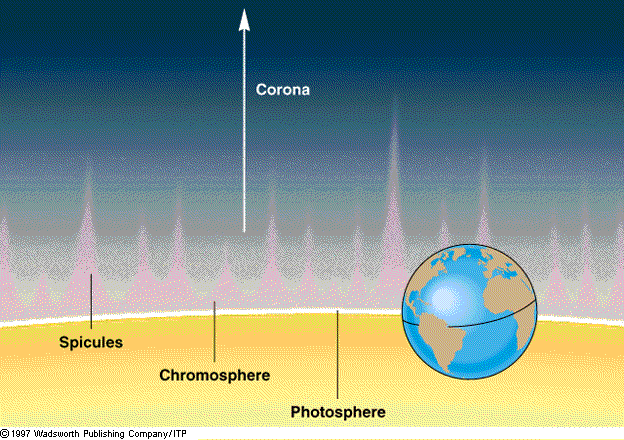
- The atmosphere lies on top and has the following layers (from innermost to outermost):
- The photosphere is about 300 km thick. Most of the Sun's visible light that we see originates from this region.
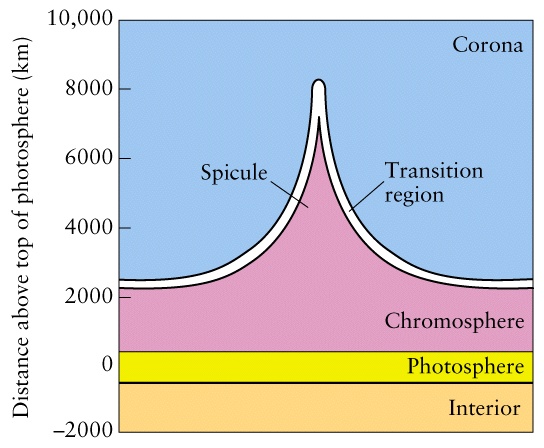
- The chromosphere is about 2000 km thick. We only see this layer and the other outer layers during an eclipse.
- The corona extends outwards for more than a solar radius.
Back Next
The Photosphere
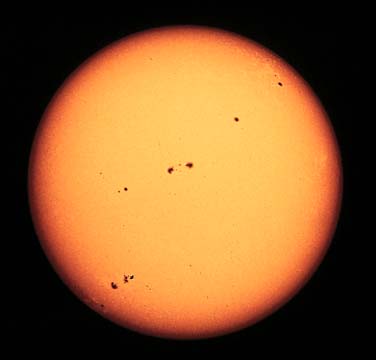
A Photo of the Sun's Photosphere shows the following features:
|  |
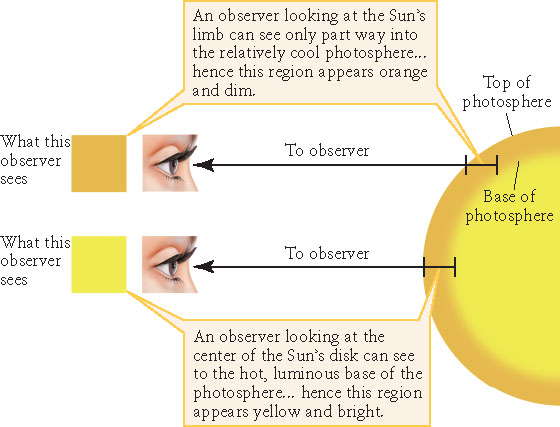
Limb Darkening: (An exaggerated diagram of the photosphere)
|
|
 | |
|
|
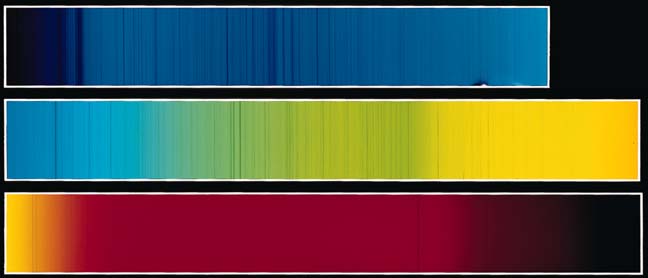
The Sun's Spectrum is an Absorption Spectrum
- Since the photosphere is cooler but less dense than the interior region it is the screen that allows the continuous blackbody spectrum to be seen through.
- Only at the wavelengths at which atoms in the photosphere can absorb light will photons be impeded in their outward travel.
- The result is an absorption spectrum, a continuous blackbody spectrum with dark absorption lines superimposed on it.
- The fact that we see an absorption spectrum when we look at the photosphere is evidence that the temperature of the photosphere decreases outwards.
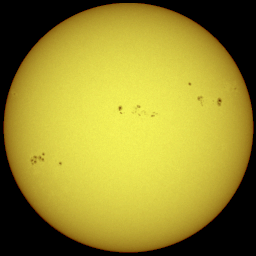
Sunspots: (Photo of the Sun taken on Jan. 17, 2005)
- Sunspots are regions with high magnetic fields (1000 x higher magnetic field than average!)
- Typical size of spots is similar to the size of the Earth.
- These regions are cooler than average, so they look darker than the surrounding hotter region.
- Sunspots are related to X-ray flares, mass ejections and the aurora seen on Earth.
Back Next
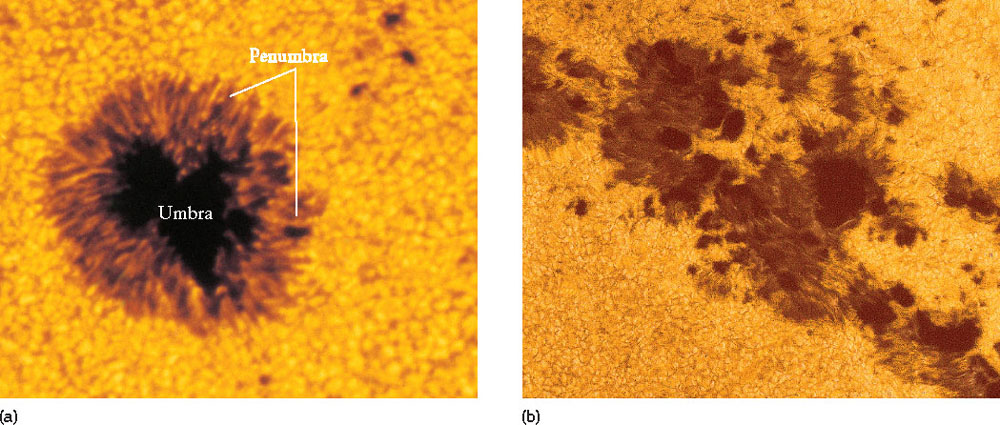
Close-up Picture of a group of Sunspots
- The darkest regions (umbra) have the largest magnetic fields and the coolest temperatures. The outer brighter region is the penumbra.
- Sunspots come in pairs: each member of the pair has opposite polarity. (I.e. one is a north magnetic pole, the other is south.)
- Each sunspot region lasts for a few days to a few weeks.
- The filaments in the penumbra are due to the magnetic lines of force.
 Back Next
 Movement of Sunspots
- Movements of spots reveal that the Sun rotates with a period close to one month.
- Equator rotates faster than the higher lattitudes. (Differential Rotation)
- You can find photos of the Sun in many different wavelengths (updated daily) at the website: http://umbra.nascom.nasa.gov/images/latest.html
Back Next
Movie of Sunspot Motion http://solarscience.msfc.nasa.gov/surface.shtml
 |
| Click on image for animation. |
Granules
Close-up Picture of the Photosphere
- Granules are the cell-like features seen on the Sun's photosphere.
- The granules are the tops of convective cells which lie in the convective zone just below the photosphere.
- Each cell ranges in size from 100 km to 1000 km across and may last up to half an hour ( dynamical time scale ! ).
- The bright regions are zones where hot gas rises.
- The dark borders are the places where the cool gas sinks.
- The gas moves outwards or inwards at speeds up to 7 km/s = 25,000 km/hour. (Measured through Doppler shifts.)
The Sun's Chromosphere
The Sun During an Eclipse
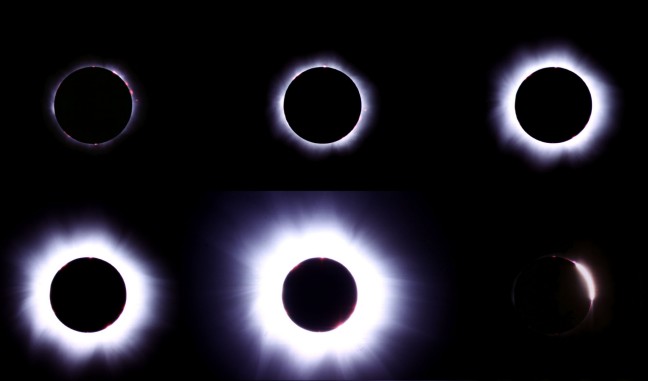
A Solar Eclipse
Back Next
The Chromosphere with a close-up of the spicules.
| 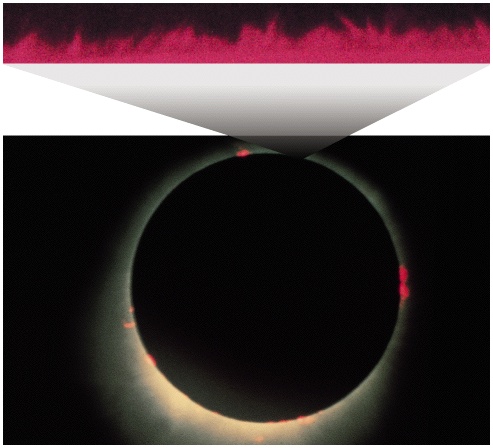 |
A diagram of a spicule
Variation of Temperature in the Sun's Atmosphere
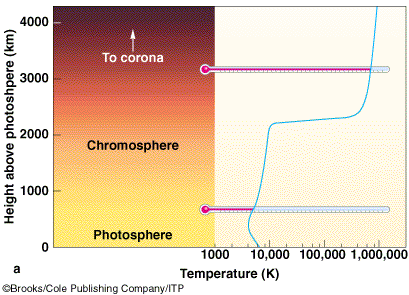
- Photosphere: Temperature decreases outwards.
- At bottom: T = 6400 K
- At top: T = 4000 K
- Chromosphere: Temperature increases outwards.
- At top: T = 10,000 K
- Transition Zone: Temperature shoots up to near 1 million K
- Corona: Temperatures increase to about 2 million K
- The source of this heat is not well understood. Current theories suggest that magnetic waves might transport energy from the convective zone to the corona.
Prominences
Back Next
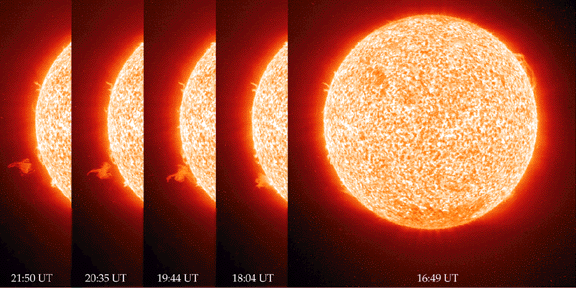
Eruptive Prominences
- Some of the prominences will erupt, causing gas to be flung outwards.
- In this picture the gas travels outwards about 70,000 km in the course of a few hours.
- Prominences are more likely to erupt when the magnetic fields near the sunspots are changing.
Next lecture: The Corona
Read Chapter 16, 8th Ed. pages 414 - 428 or 3rd Ed. pages ???.
mccorkledepud1987.blogspot.com
Source: https://sites.ualberta.ca/~pogosyan/teaching/ASTRO_122/lect9/lecture9.html

Post a Comment for "Which Atmispheric Later is Associated With the Suns Continuous Spectrum"